


¡Hola profes! How did the transition back to school after winter break go? Hopefully it was as seamless as possible!
It’s hard to believe that the second semester is almost here – or maybe even already here, for some of us! While it’s super exciting to know that we’ve made it through half of the year, it’s also common to see a decrease in student engagement at this time of the year. Here’s a blog post that can give you some ideas about how to get your students through the third-quarter slump!
In this post, I wanted to specifically address students’ use of Spanish in the classroom and how you can keep your students using the target language during class activities. At the beginning of the year, your students might have been more excited and willing to speak in Spanish in class, but you may have noticed that now, students are more likely to use English. Here are some ideas that I use in my classroom to keep my students using Spanish.
#1: Provide Scaffolding and Structure
Students may revert to English during class activities not because they have an aversion to speaking in Spanish, but because they are struggling and need some extra support. This may become more common as the year goes on and the course material becomes more challenging. Here are some speaking activities that provide scaffolding and support that students need, but still get them speaking in the target language:
Information Gap Activities
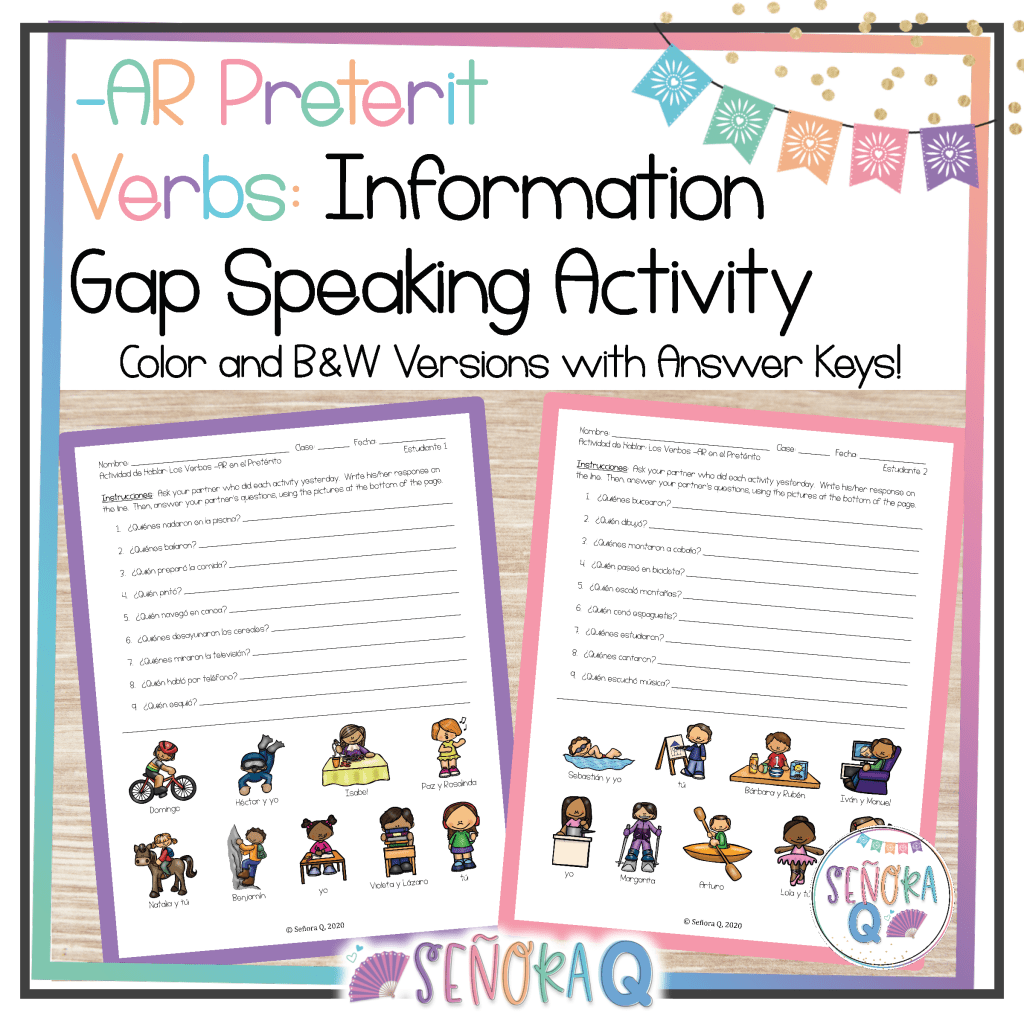
Information gap activities require students to speak to a partner to ask for and share information. Each partner has a half-complete paper, and so the students must speak to each other to get the missing information. They are easy to create, provide scaffolding for students, and work with virtually any topic!
When I create information gap activities, I will typically put 8-10 questions at the top of the paper. Each partner has a different set of questions. For example, if we’re studying places in the school, I would write a question like, “¿Dónde está Marta?” on Estudiante 1’s paper.
Then, underneath the questions, I put picture prompts that students will use to answer their partner’s questions. So, on Estudiante 2’s paper, I would write Marta’s name and have an image of a cafeteria under it. So, when Estudiante 1 asks, “¿Dónde está Marta?”, Estudiante 2 can answer with, “Marta está en la cafetería.” Estudiante 1 then writes that down on his/her paper. Students switch roles until all questions have been asked and answered.
Since students already have the questions that they need to ask their partners and picture prompts to help them form the answers, students are much more likely to complete the activity in Spanish! The extra support will provide them with the confidence that they need to not feel as though they have to use English to complete the activity.
Want to try an information gap activity with your students? Here are some of my favorites!


Partner Interviews
Have students interview one another, but provide them with a list of questions to ask. You can require that students ask each other all of the questions, or choose a certain number. If desired, you could also provide sentence starters to help students answer in the target language. For example, if one of the questions is, “¿Cuál es tu clase favorita?”, you could write below it, “Mi clase favorita es…” or you could include a list of possible school subjects to choose from.
For accountability purposes, you could choose to have students share a bit about their partners, either verbally or in writing in Spanish. This will encourage students to conduct the activity in Spanish, since they will have to report out in Spanish as well!
Looking for lists of questions you can have students use during partner interviews? I’ve got you covered!


Simulated Conversations
If you want to help develop your students’ impromptu conversational abilities in Spanish and/or prepare them for eventual success on the AP Spanish Language and Culture exam, the simulated conversation is a great activity to add to your repertoire!
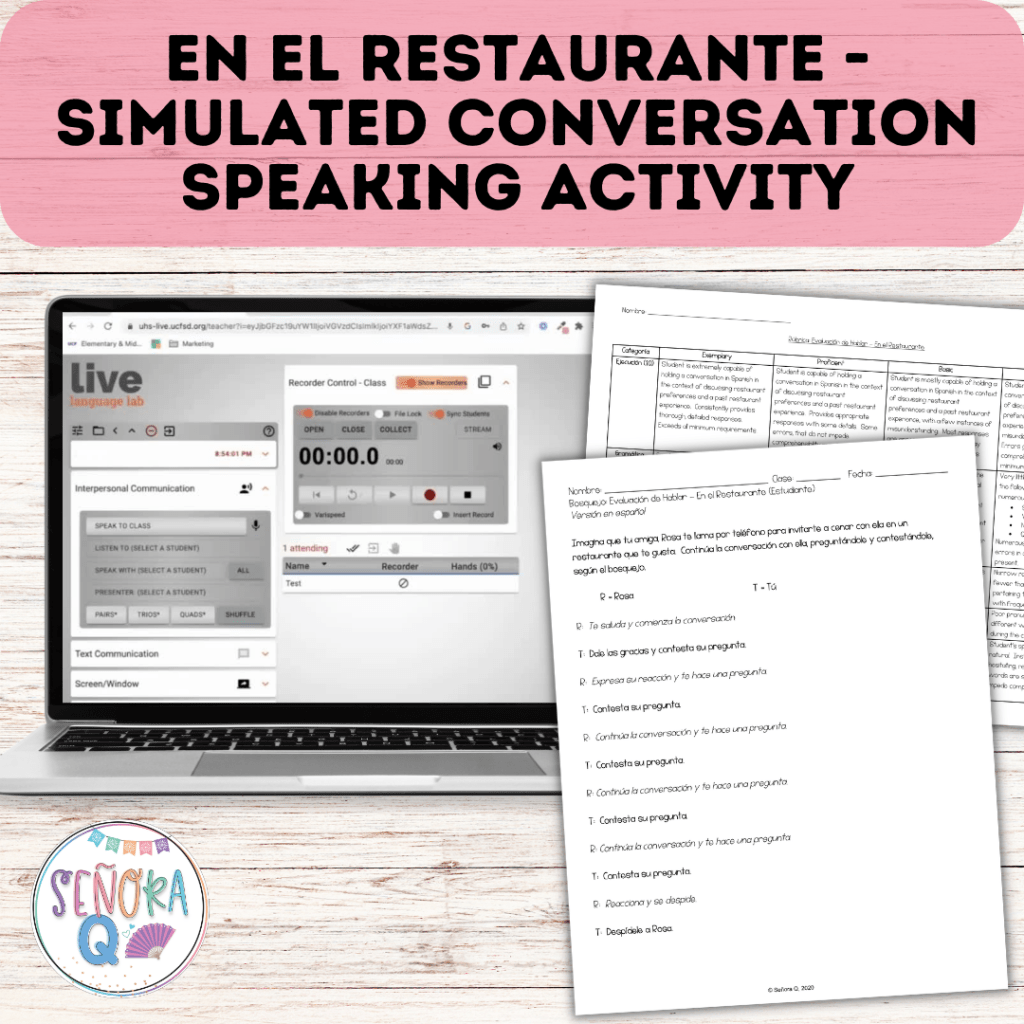
Basically, the purpose of a simulated conversation is to replicate (as closely as possible) a conversation that students might have in Spanish in situations outside of the classroom. Topics might include: ordering at a restaurant, talking to a doctor, or getting to know a partner student in an exchange program. Students hear an opening line to the conversation, and then respond. They then hear the second line of conversation and respond again. This goes on for as long as you like, but I think five exchanges is the maximum you should include.
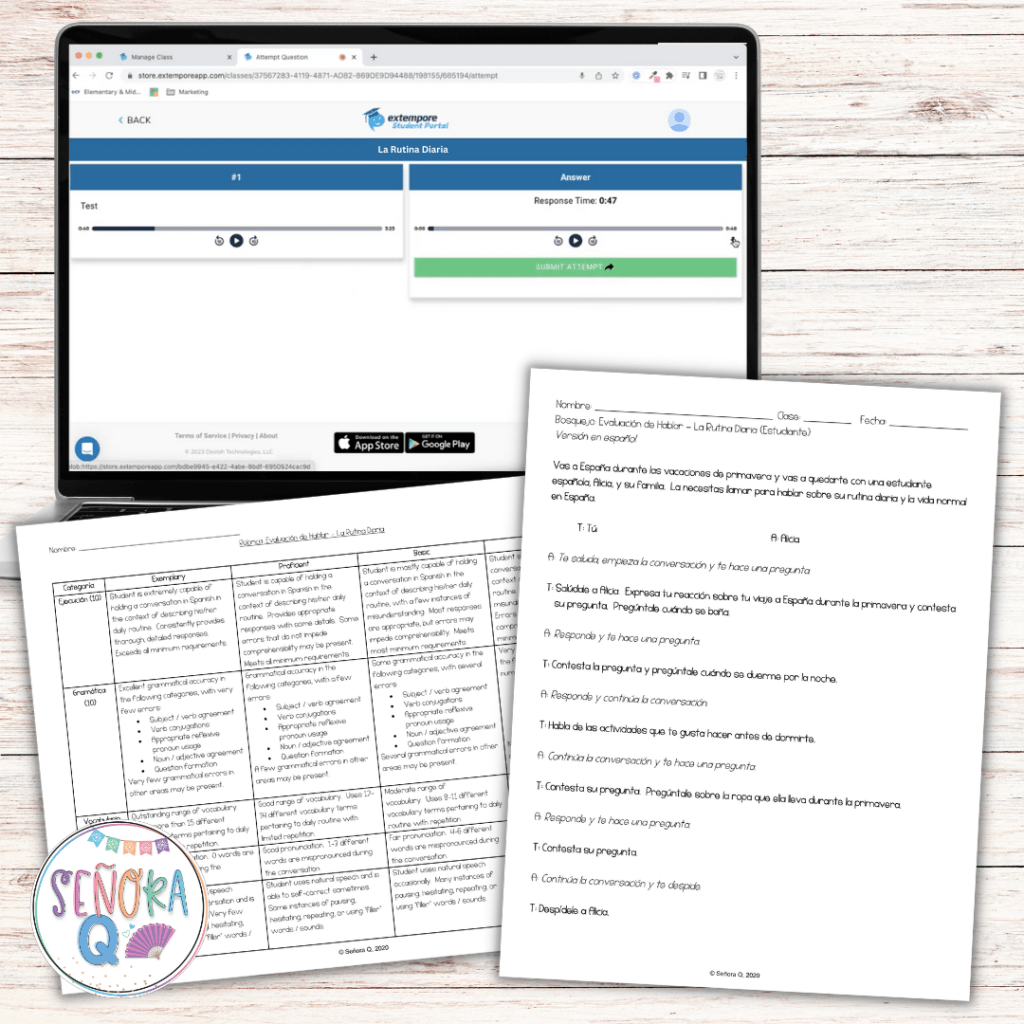
It is super, super helpful to use technology to help you conduct simulated conversation activities. Having a pre-made recording of the conversation prompts that students will respond to is so beneficial and keeps the activity running smoothly. Here is a list of websites and apps that you can use to help conduct simulated conversation activities!
Now, students don’t have to go into the conversation without any support – it’s a great idea to include a conversation outline to guide students through the activity. Students even get one on the AP exam! At the top, I briefly describe the scenario so that students have some context for the conversation. Then, I provide prompts (but not a transcript) to help students complete the task. Here’s an example of what one of my conversation outlines looks like:

I’ve put together my favorite simulated conversations that I use in Spanish 1-4 below!

#2: Have students record themselves during speaking activities in class.
When students are completing a speaking activity in class, have them record themselves using their cell phones or other electronic devices. Then, have students share their recordings with you in some way – I like to create an assignment on Canvas, my school’s LMS, and have students upload their recordings there. However, you could also have your students email their recordings or share them with you via Google Drive. You absolutely do NOT have to listen to or grade every single conversation, however! I usually pick a few assignments at random per marking period and grade them based on students’ effort and use of Spanish during the assignment. I do not take off points for making mistakes. I have found that this motivates my students to speak in Spanish when they are supposed to during class activities!
#3: Make speaking in Spanish a part of your class participation rubric.
If you use class participation rubrics, adding a section specifically for using Spanish during class activities is a great way to motivate your students to use Spanish during class!
Here’s what your rubric descriptors might say:
- Excellent: I always use Spanish to respond to the teacher and use Spanish with classmates during structured activities. I am also able to initiate conversations in Spanish.
- Good: I mostly use Spanish to respond to the teacher and use Spanish with classmates during structured activities.
- Average: I somewhat use Spanish to respond to the teacher and somewhat use Spanish with classmates during structured activities, but I could use more.
- Below Average: I speak as little Spanish as possible during class and pair and group activities.
Don’t worry if you haven’t been using class participation rubrics so far this year – it’s a new semester and a perfect time to add one in! Just make sure you go over the rubric with your students so they understand what is expected of them.
A tip with class participation rubrics: It’s a good idea to have students evaluate themselves mid-marking period to assess their own progress and make a plan for improvement, if necessary. This has two benefits: improving students’ use of Spanish in class, and helping students avoid any potentially unpleasant surprises at the end of the marking period.
I hope this was helpful and you’ve found some ideas that you can use in your classroom! Please feel free to leave me a comment or send me an email if you have any questions! Have a wonderful week, profe!
 Señora Q