


¡Hola profe! How are you doing this week? Hopefully all is going well in your classes, and you and your students are settling in and getting along well!
This week, I wanted to start a detailed series about how to introduce lower-level Spanish students to AP Spanish Language and Culture test tasks. I firmly believe that preparing students for AP success begins in Spanish 1. The more students practice the tasks in the years leading up to AP, the more they’ll feel like second nature to students. They will know what to expect from the test, and what the test will expect from them.
The first AP test task that I wanted to discuss is the email reply. This is a free-response, interpersonal writing task in which students read an email and write a coherent, detailed response. Students have 15 minutes to both read the email and write their replies, and must use the formal register (usted) and formal language to respond. Additionally, students should include a greeting, a farewell, and additional questions or requests for clarification. You can read more about the exam and the scoring criteria, and download helpful guides, student samples, and more on the AP Central website.
Phew! That’s a LOT for students to do in just 15 minutes. The good news is that the task WILL become easier and more manageable for students with practice.
So, how can you start practicing the email reply with lower-level students? First and foremost, make sure that you keep your expectations consistent with students’ current proficiency levels. Can a Spanish 1 or Spanish 2 student communicate at the same level as an AP student? No. Can they still read a comprehensible email and write a response using vocabulary and structures that they know? Absolutely!
Next, teach students about the task and provide scaffolding and support when needed. Your lower-level students will likely become overwhelmed if you give them an email (even a comprehensible one), set a timer for 15 minutes, and instruct them to read the message and write a reply. You can certainly work up to that, but here are some ideas for scaffolding the email reply task to help establish familiarity and comfort levels with your lower-level students:
#1: Read an email and write a reply as a class.
This is a great way to get started with the email reply task! Reading a message and writing a response alone can feel completely staggering for students when they’re first starting out. A better idea is to complete the task together and allow students to become more comfortable with the task. Start by reading the email together out loud – you could read it to students as they follow along silently, or you could have students volunteer to read a sentence or two at a time. Have students point out key words/phrases or questions/requests for information within the email. If you wish, you could ask a few informal comprehension questions along the way to make sure your students understand (and if you see that they’re struggling a bit, provide additional clarification as needed).
Then, begin writing a response as a class. Go over with students the elements that are needed for a successful reply: a greeting, a farewell, answers to all questions, details/elaboration, and asking additional questions. I like to hang chart paper on my board and write in large print so everyone can see. You could also have a student volunteer scribe for you! To help students visualize the different parts of the email, I use different color markers for each section (i.e., red for the greeting, orange for direct answers to questions, etc.).
To show students that there are numerous possibilities for writing the email, you could brainstorm a list of different greetings, ways to respond to various questions, etc. and then the class could vote as to which they would like to include in the final draft. Once the draft is done, see if a colleague would be willing to read the draft and give it some feedback and a score using the AP rubric. Then, you can share this information with the class. With guidance and scaffolding, your students will likely be successful, which will build confidence levels and increase students’ willingness to try the task again in the future.
#2: Have students read and write in pairs/small groups.
After you have written a few email replies with your students as a class, place students in groups of 2-3 and have them complete this task together. Circulate amongst the groups and remind them about how you worked through the email reply as a class, and remind them to use the same strategies and techniques. Offer feedback and answer questions as you go! Afterwards, you can hang up each group’s reply and do a gallery walk. Have students comment on what each group did well. Alternatively, you could type up one group’s response, removing any names, and score it with your students as a class using the AP rubric.
#3: Provide a list of useful words/phrases for this task.
This is a great support for students, especially when you are starting to introduce and incorporate formal language! Personally, I let my students use this list as they write up through level 4, which is a pre-AP course. I photocopy the list on a bright-colored paper so my students can find it easily throughout the year!
Here are some phrases I like to incorporate:
Greeting:
- Estimado/a Sr./Sra./Srta. ______________________ (last name)
Say Thank You:
- He recibido su correo electrónico y le agradezco por mandarlo/responderme.
Begin Response:
- Le escribo a usted en referencia a…
- Para responder a este asunto…
- En respuesta a…
- Le escribo a usted para pedir más información sobre…
- Estoy interesado/a en…
- Quisiera saber…
- Estoy entusiasmado/a de participar…
- Estoy agradecido/a por la oportunidad…
Request More Information:
- Si me permite, tengo algunas preguntas con respeto a…
Express Gratitude/Interest:
- Le agradezco de antemano…
- Si requiere información adicional, no dude en contactarme.
Farewells:
- Atentamente
- Le saluda atentamente
- Respetuosamente
- Cordialmente
- Se despide cordialmente
#4: Have students write a draft individually and provide feedback/peer edit.
When students begin writing individual email replies, allowing them to write a rough draft first can be really beneficial. Give your students the opportunity to see what they can write on their own. You may want to allow extra support, such as a list of useful phrases. Once they’ve written their drafts, have students show you their work for feedback, or you could have your students complete a peer-edit. Then, students can make corrections based on the feedback before turning in a final version.
#5: Have students write with no time restrictions/reducing writing time gradually.
Completing the email reply in 15 minutes is TOUGH. There’s a lot that students need to do in a short time period, and while 15 minutes may be appropriate for AP students, it most likely is not for your lower-level students. When you start incorporating email replies into your classes, do not impose such a strict time limit. I allow my Spanish 1, 2, and 3 students 40 minutes to complete this task when writing individually.
If you think your students are comfortable with email replies and want to start getting them accustomed to the time limit, reduce the amount of time you give gradually.
Here’s how I reduce the time with my Spanish 4 (pre-AP) students:
- Marking period 1: 5 minutes to read email + 30 minutes to write responses
- Marking period 2: 5 minutes to read email + 25 minutes to write responses
- Marking period 3: 5 minutes to read email + 20 minutes to write responses
- Marking period 4: 5 minutes to read email + 15 minutes to write responses
When my Spanish 4 students move on to AP, my colleagues gradually remove the 5 minutes allotted for reading the email so that by the time the exam comes around in May, students are completely prepared to complete the task in 15 minutes!
Final takeaway: It can seem daunting to try AP tasks with lower-level students. Believe me, I was SO skeptical when I first started, too. But I promise that, with the proper scaffolding and support, your students absolutely can do it!
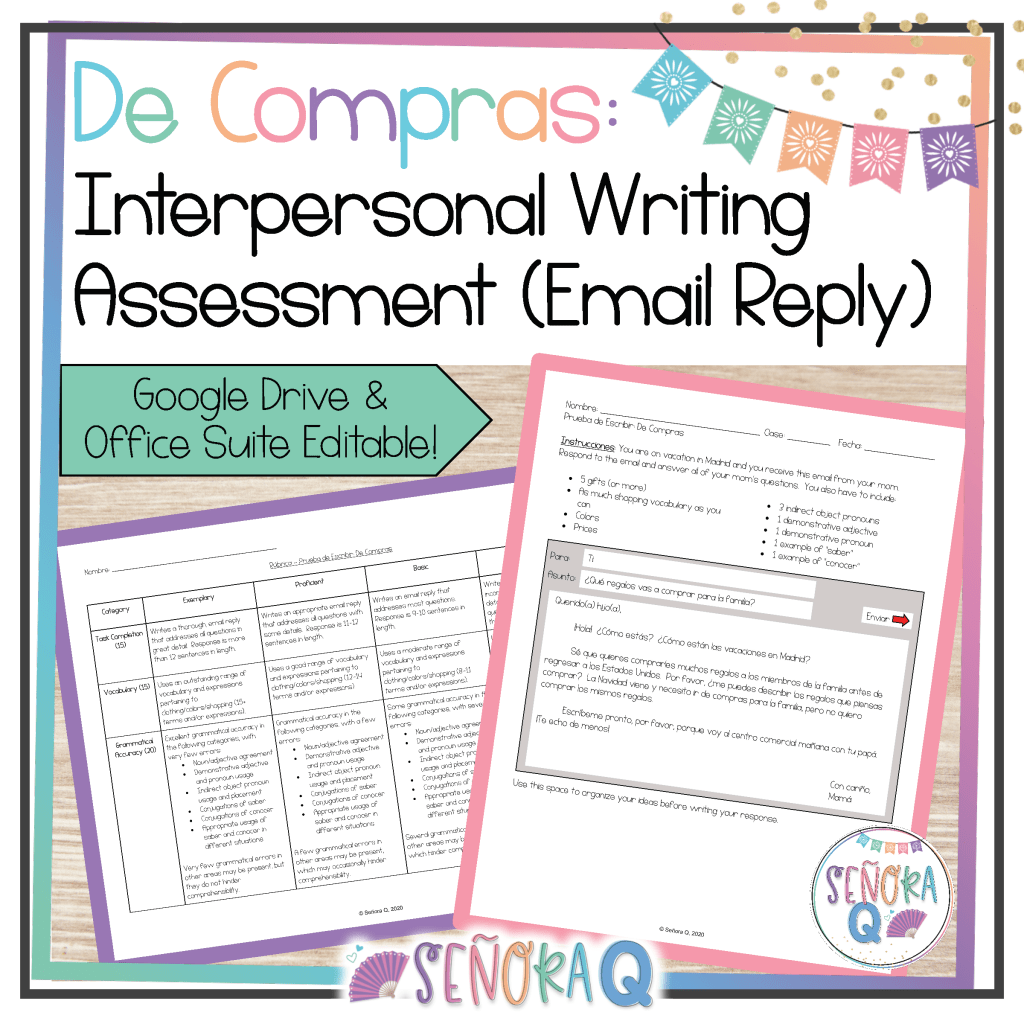
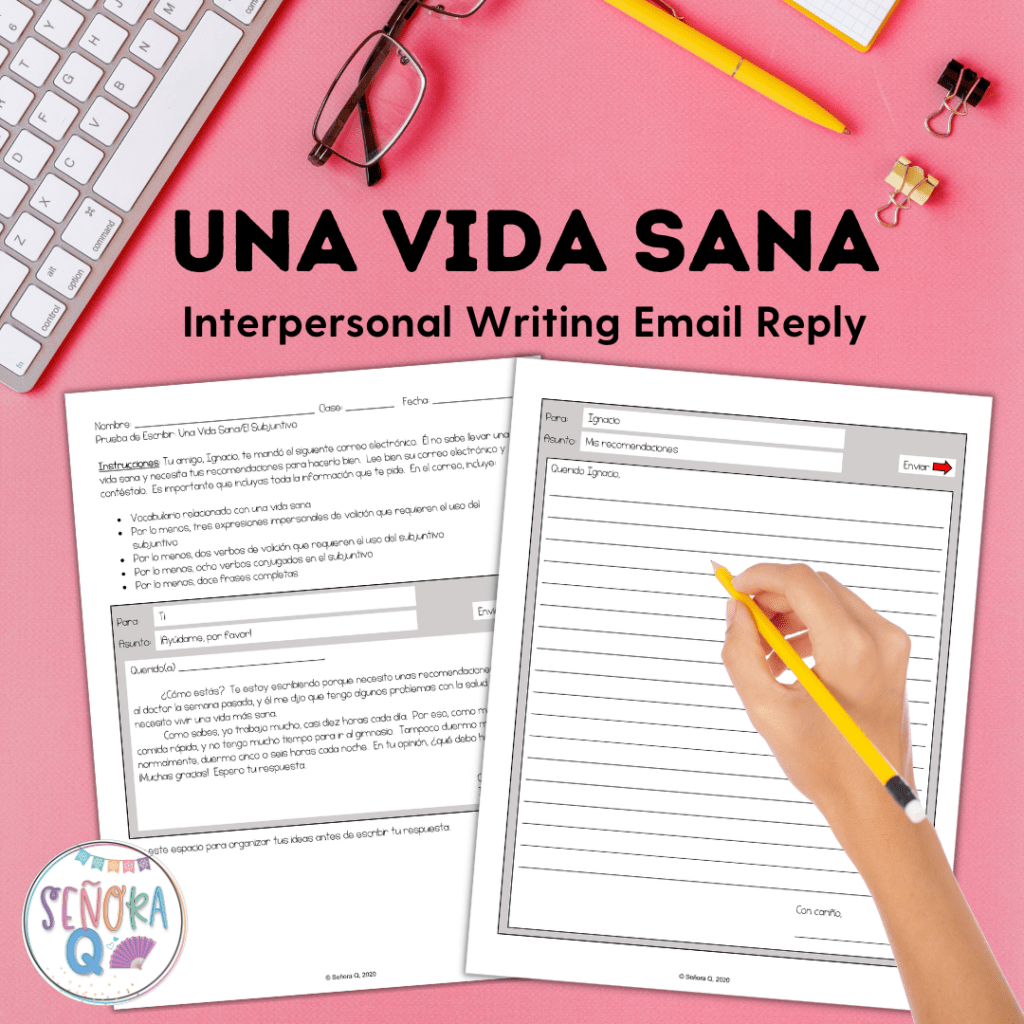
If you’re looking for email replies that you can utilize in your lower-level classes, here are some of my favorites:
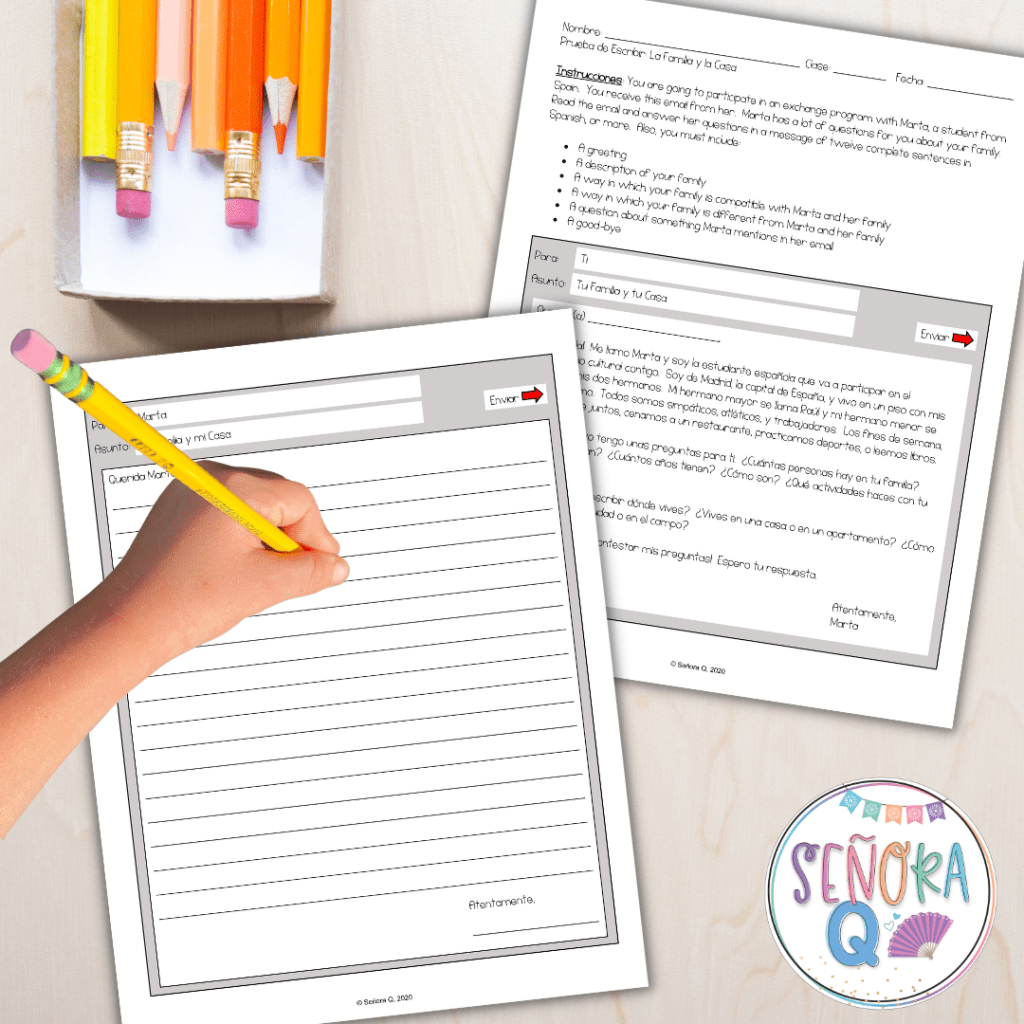
Try it Free!
Sign up below to receive a FREE email reply on family life that your Spanish 1 students can totally rock!


I hope this was helpful! Please feel free to leave me a comment or send me a message if you have any questions about getting started with the email reply! Have a wonderful week, profe!
 Señora Q