


¡Hola profe! Have you gone back to school yet? If so, hopefully it’s been going well! If not, I hope you’re enjoying the rest of your summer break!
Whether or not you’ve officially started the school year, you might be asking yourself how you can get your students to speak more Spanish in class and to improve their speaking abilities. Here are 3 easy-to-implement speaking activities that you can incorporate into any unit:
#1: Information Gap Activities
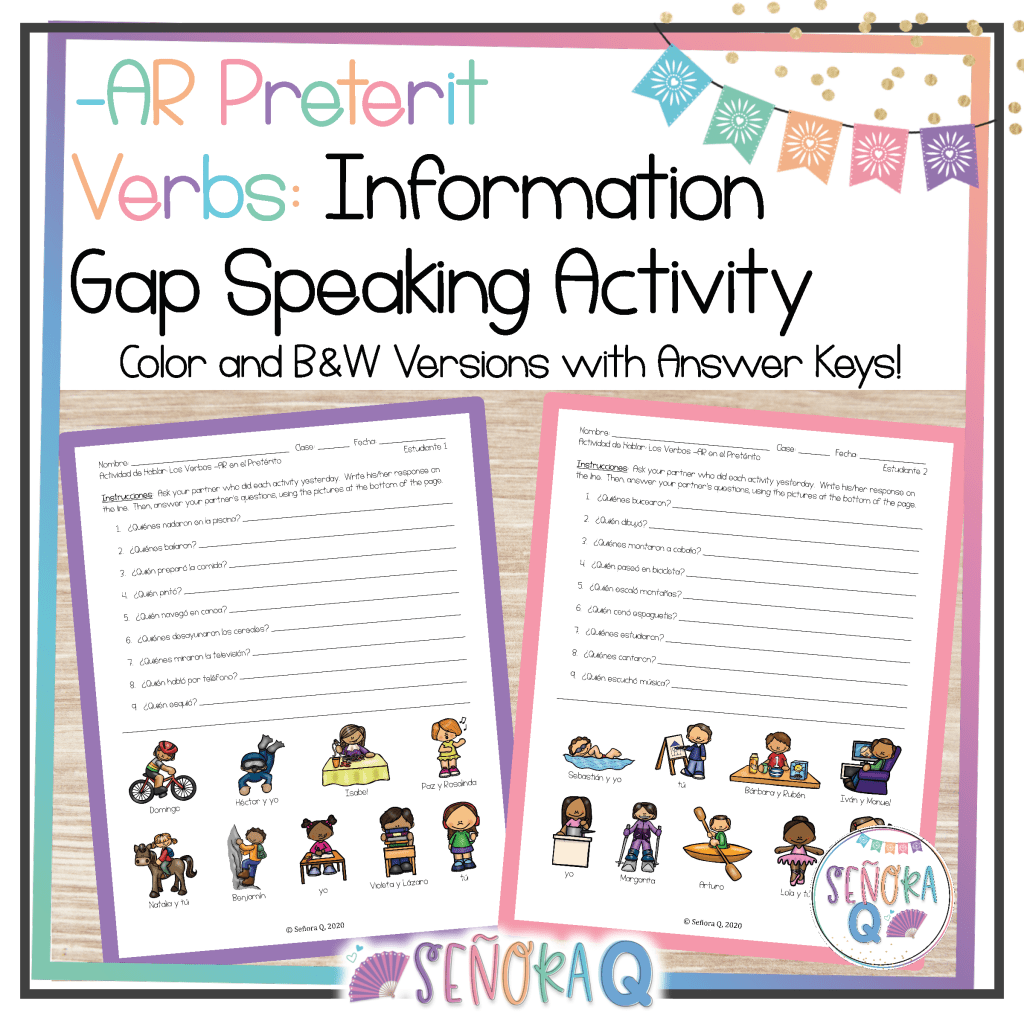
Information gap activities require students to speak to a partner to ask for and share information. Each partner has a half-complete paper, and so the students must speak to each other to get the missing information. They are easy to create, provide scaffolding for students, and work with virtually any topic!
When I create information gap activities, I will typically put 8-10 questions at the top of the paper. Each partner has a different set of questions. For example, if we’re studying places in the school, I would write a question like, “¿Dónde está Marta?” on Estudiante 1’s paper.
Then, underneath the questions, I put picture prompts that students will use to answer their partner’s questions. So, on Estudiante 2’s paper, I would write Marta’s name and have an image of a cafeteria under it. So, when Estudiante 1 asks, “¿Dónde está Marta?”, Estudiante 2 can answer with, “Marta está en la cafetería.” Estudiante 1 then writes that down on his/her paper. Students switch roles until all questions have been asked and answered.
Want to try an information gap activity with your students? Here are some of my favorites!


#2: Partner Interviews
One thing that I have found about teaching high-school students is that the majority of them like to share about themselves. Not only do partner interviews allow students to practice speaking in Spanish, they also add a personalized aspect to our units that make students feel more connected to the content, as they can see how it relates to their lives.
When I conduct partner interviews, I will give students a list of questions to ask to a partner. Students record their partners’ responses. After the activity is completed, I like to have students share 1 thing they learned about their partners with the class. For upper-level students, I sometimes have students answer the questions about themselves first, then interview partners, and share a similarity or difference between themselves and their partners. For example, if the topic was daily routine, students might say, “Yo me ducho por la mañana, pero mi compañero se ducha por la noche” as their difference. Not only is this a great way to practice speaking, it allows students numerous opportunities throughout the year to get to know their classmates, helping to build a stronger classroom community.
Looking for lists of questions you can have students use during partner interviews? I’ve got you covered!


#3: Simulated Conversations
Profe, wouldn’t it be great if our students left our classrooms able to hold a conversation in Spanish? Sure, they will likely make mistakes, but wouldn’t it be AMAZING if our students could communicate with other Spanish-speakers?
The truth of the matter is, if this is what we want our students to be able to do, they have to regularly practice holding conversations in the target language. Not only is this excellent preparation for students who will go on to take the AP Spanish Language and Culture exam, but it will help all students successfully use Spanish outside of our classrooms in real-world settings. I can’t think of a Spanish teacher who wouldn’t want that!
So, how can we help increase our students’ abilities to hold a conversation in Spanish? The simulated conversation is a great activity to incorporate into your units! At first, it may seem daunting, maybe even impossible, for novice learners, but I promise that it’s doable! You can include a simulated conversation in your very first unit of Spanish 1! Have your students pretend they are introducing themselves to a classmate. They can exchange names, ages, how they are doing, where they are from, and so on!
The first thing you’ll need for a simulated conversation is a script. What questions/prompts are your students going to listen and respond to? Once you have your script, I recommend making a recording of you or a colleague reading it. Make sure to leave time between each question/prompt for your students to answer! (I usually leave 20-30 seconds.) A recording will be necessary if you plan to use technology to have students complete the simulated conversation!
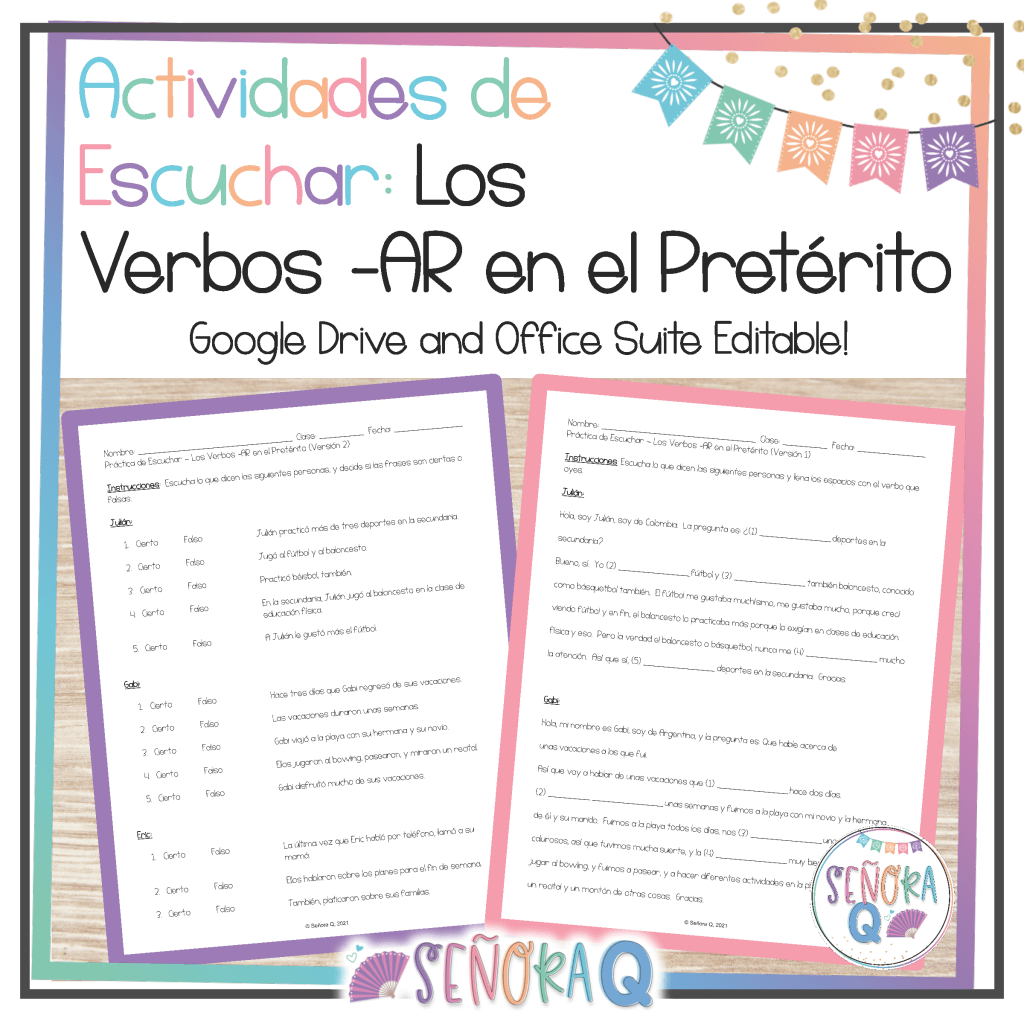
The next thing you’ll need to create is a conversation outline to guide students through the activity. At the top, I briefly describe the scenario so that students have some context for the conversation. Then, I provide prompts (but not a transcript) to help students complete the task. Here’s an example of what one of my conversation outlines looks like:

There are lots of different ways you could go about completing a simulated conversation in your classroom. I prefer to use technology to record the conversations so I can listen to students’ responses multiple times, and to allow students to listen to their own recordings and reflect. These are some great options:
- Play your recording of the conversation through your classroom speaker and have students record their responses via the Voice Memos app (iPads/iPhones) or Camera app (Chromebooks). Other recording programs, apps, or extensions may be available for your students to use, depending on their specific devices. Have students share their recordings with you in some way (email, upload to your LMS, etc.).
- Create an assignment on your LMS (Canvas, Google Classroom, etc.), and have your students create a screen recording, giving their responses as you play the recording of the conversation. This will make it easy for you to collect students’ answers!
- Use a website such as Charlala or Extempore. Both sites can be used for free, with upgraded features available for purchase if you like.
Lastly, you will need a rubric to assess your students. Luckily, the AP rubric for interpersonal speaking works great for simulated conversations at any level! If you feel that any criteria on the AP rubric are not applicable for your students at any given time, you can ignore them – that’s what I’ve always done in those cases!
I’ve put together my favorite simulated conversations that I use in Spanish 1-4 below!


I hope this was helpful! Please feel free to leave me a comment or send me an email if you have any questions! Have a wonderful week, profe!
 Señora Q