

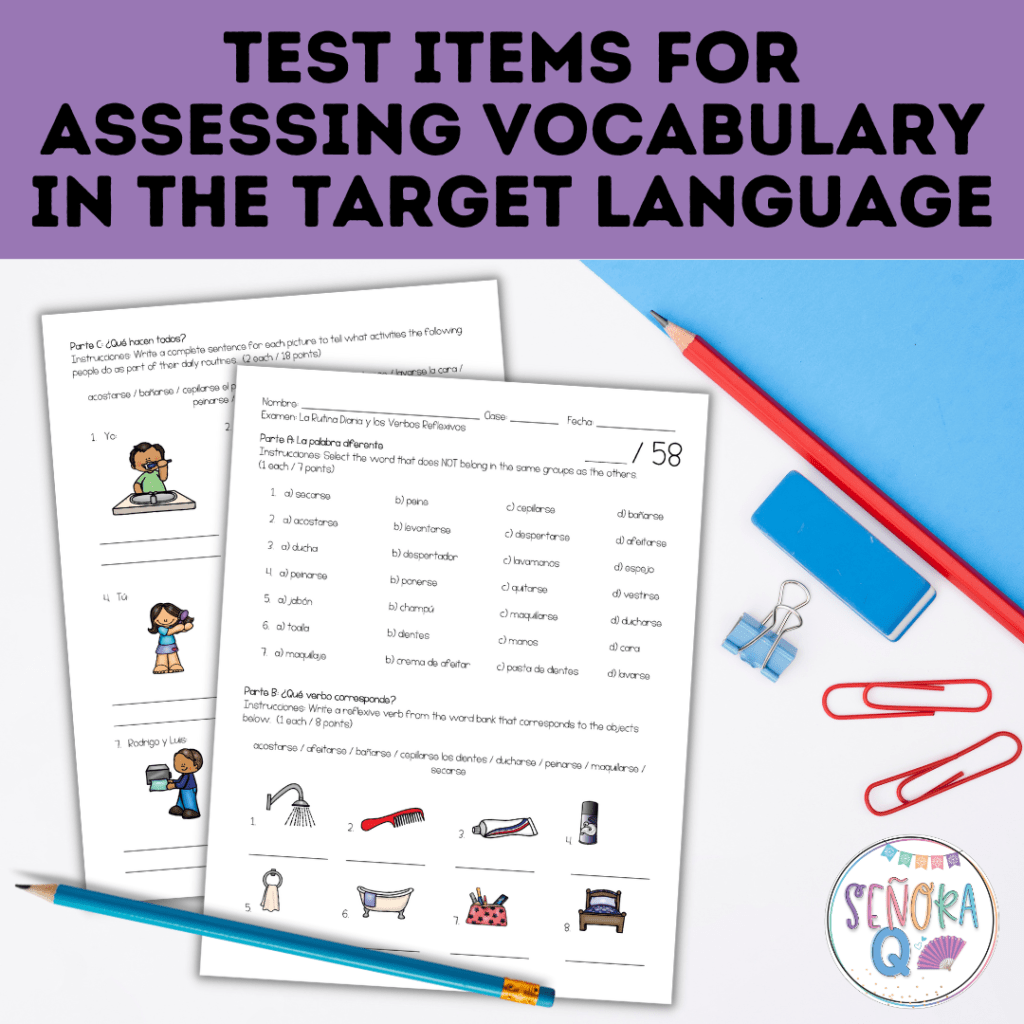

¡Hola profes! Does this sound familiar? You’ve got your vocabulary lesson or unit planned out – you know what material you need to cover, you’ve got some great ideas for activities, and you have a rough timeline prepared. All that’s missing is your assessment piece.
Of course, there are so many ways you can assess your students – projects, performance-based tasks like simulated conversations or email replies, and portfolios, just to name a few – but if you are planning to give a written quiz or test, it can be so time-consuming trying to think of different types of questions to ask students.
I used to absolutely dread writing tests and quizzes. Just thinking of ideas seemed to take forever! But now, I find that writing tests and quizzes doesn’t take me as much time as it used to, and I strongly believe it’s because I have a go-to list of question types that I incorporate on virtually all of my vocabulary tests and quizzes. I wanted to share my favorites with you to hopefully give you some ideas and, ultimately, save you time and energy!
#1: Choose the word/phrase that doesn’t belong
With these types of questions, present your students with approximately 4 words or phrases from your lesson or unit. Three of them should be related to each other in some way, and the fourth item should be different. For example, on a clothing/colors assessment, you could give your students 3 colors and 1 clothing item. Students would need to identify the article of clothing as being the word that doesn’t belong.
I love “Choose the word/phrase that doesn’t belong” sections because they work with any topic and are easy questions to write! Additionally, in my experience, the majority of students are successful with these questions. I will typically put this section with 5-6 questions at the beginning of the assessment to build my students’ confidence levels and help reduce any feelings of anxiety or panic that they won’t be able to answer any of the questions.
Here are some variations/extensions you could use with this section:
- Have students identify the word/phrase that doesn’t belong and explain their reasoning.
- Have students identify the word/phrase that doesn’t belong and suggest a word/phrase from their vocabulary that WOULD fit with the other three terms.
- Give students a series of 4 words and ask them to identify if they are related or not. If there is a relationship, have students identify it (i.e., all are clothing items, all are colors, all are foods, etc.).
#2 Lógico/Ilógico
With lógico/ilógico questions, present your students with a statement that includes your vocabulary words, and have them identify if the statement is logical or illogical. For example, you might say: “I’m going to the pool with my friends because I don’t like to swim.” I like lógico/ilógico questions because they provide students with comprehensible input and allow your students to see their vocabulary words in context. They are also pretty simple to write!
Here are some variations/extensions you could use with this section:
- Have students rewrite the illogical statements so that they become logical.
- For upper-level students, have them explain (in Spanish) why illogical statements are illogical.
- Allow students to be creative and task them with writing their own silly, illogical statements! Ask students to explain why their sentences are illogical, or have them illustrate their sentences to demonstrate their understanding.
#3: Fill-in-the-Blank Sentences
Fill-in-the-blank sentences are pretty straightforward, but so versatile. There are so many options for variation and expansion! Typically, I will provide students with incomplete sentences, and will ask them to use vocabulary words from our lesson or unit to finish the sentences in a logical way. While some of your sentences might have only one logical response depending on the vocabulary you are studying, you can make it so there are numerous ways to complete the sentences when possible. For example, you could ask students in the target language, “I wear _________ to the beach.” There are several correct answers – a bathing suit, sandals, shorts, and more.
Here are some ways to vary this activity for your students:
- Provide a word bank for students who need extra scaffolding. I like to add a few extra terms to my word banks that students will not use. This helps hold students accountable while also giving students the extra support they might need.
- Have students write follow-up sentences or questions in which they request additional information about the original statement. For example, if the completed sentence says, “I wear a bathing suit to the beach,” they could write a second sentence that says, “My bathing suit is yellow and blue.”
- Instead of individual sentences, write a story with connected sentences for students to complete. This increases the level of difficulty for students who may need an additional challenge.
#4: Form Sentences/Stories with Picture Prompts
Using picture prompts is a great way to allow your students to use the target language to show their creativity! Another perk is that you can make this activity as simple or as complex as you like to best meet your students’ needs. You can add some word cues as well to provide extra support and direction if that works for you!
Typically, I will give my lower-level students an image and a subject to help them start their sentences. With my higher-level students, I like to provide a full scene and have my students describe it to me. This way, they can use transition and connecting words and can showcase their abilities to expand and elaborate in Spanish!
Here are some variations/expansions you can try:
- For students who need extra support, provide a word bank for them to utilize as they create their sentences.
- Give your students a series of pictures. Students put the pictures in a logical, sequential order, and write a sentence about each one. This is great for talking about daily routines!
- Create a reading activity for students – provide sentences and have your students illustrate them to show that they understand what they’ve read!
#5: Preguntas Personales
If you read my post about writing activities, you know that I love using preguntas personales to help students make personal connections to the vocabulary we are studying. Preguntas personales are very easy to write and can be utilized with practically any set of vocabulary. All you need to do is ask students about their habits, opinions, thoughts, and/or experiences pertaining to the content of your lesson. For example, if you’re studying clothing, ask students to describe the outfits that they’re wearing that day, or what they wear to go to certain places or do certain activities. Using preguntas personales is also wonderful for allowing your students to see their vocabulary words in context!
These are some variations you can use, too:
- Switch the subjects of the questions so that students must use a variety of subjects in their answers (yo, nosotros(as), ellos/ellas, etc.).
- Have students respond to connected preguntas personales in the form of a written dialogue or conversation.
- Provide answers and have students write logical corresponding questions.
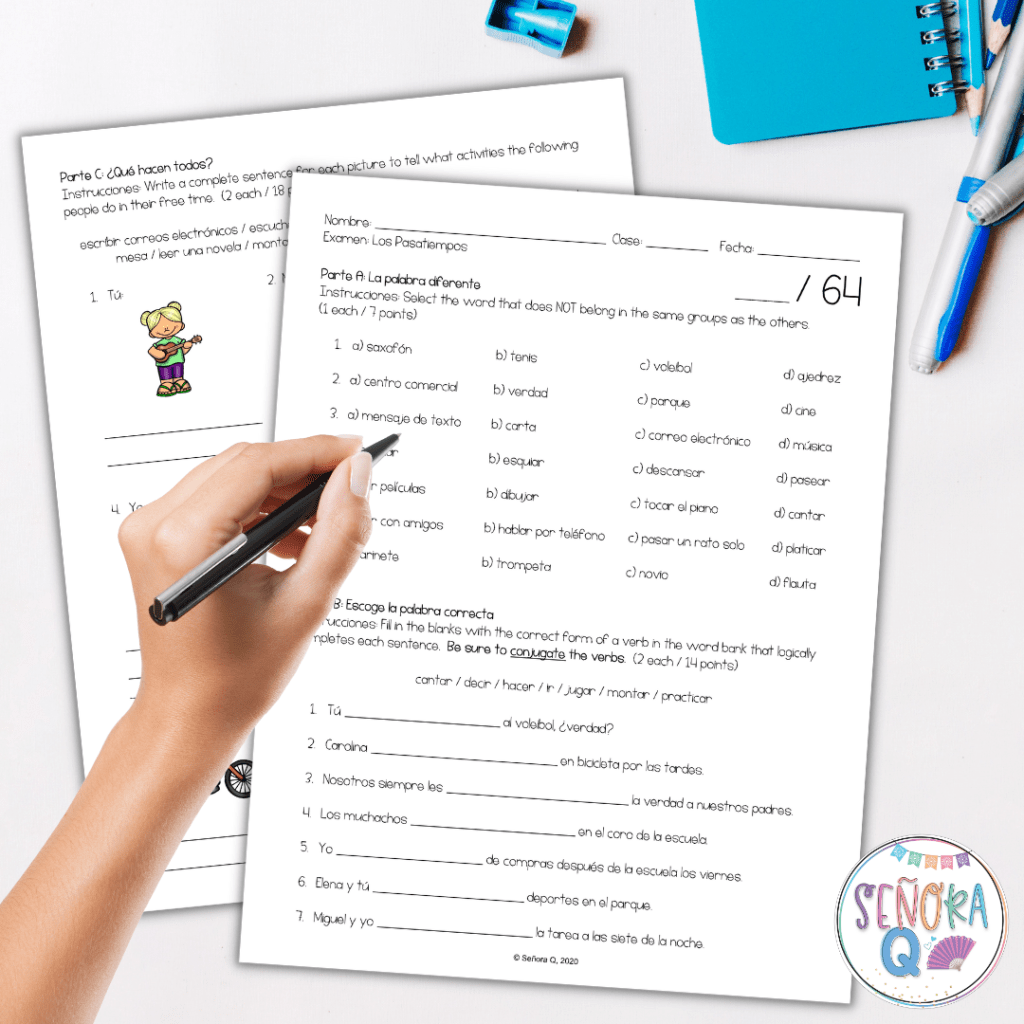
I hope these suggestions were helpful, profe! But, if writing test items still seems daunting or is just not something you’d like to spend your time on, I’ve got you covered! I have ready-to-use assessments for you – check out some of my favorites below!


 Señora Q