


¡Hola, profes! Today’s topic is one of my passions – helping my students gain the knowledge, skills, and confidence needed to succeed on the AP Spanish Language and Culture exam!
If a school or school district offers an AP Spanish Language and Culture course, it is probably the culminating course of the program and will require students to use knowledge and skills that they’ve been building for years. This means that, for optimal success, students need to start preparing for this course beginning in Spanish 1.
You may be thinking, “There’s no way Spanish 1 students can complete AP tasks!” or “How can I fit this into my already jam-packed curriculum?” I totally get it, because I used to have those thoughts myself. But I promise you, it IS possible, and when your students get to the AP level, they will come back and thank you for the years you spent preparing them for success.
Many years ago, when I began working in my current district, I spoke to a colleague who teaches AP Spanish Language and Culture. She told me that, while students certainly improve throughout the year, many could take the AP exam on day 1 of her course and score a 4 or a 5.
Profe, my mind. was. blown.
I asked her how that was possible?? She told me that it was because of how students are prepared in Spanish 1-4 and that the crucial component is nurturing the right skills from the beginning. Over the past 10 years of teaching Spanish 1-4 on the AP track, I have come to see that this is 100% accurate!
Here’s what you can do in your Spanish 1-4 classes to help your students become AP-ready:
Super important side note: Make sure you familiarize yourself with the AP Spanish Language and Culture exam, if you don’t know much about it! Knowing what your students need to do on the AP exam will better enable you to prepare them. You can read all about the exam and the scoring criteria, and download really helpful guides, audios, student samples and more on the AP Central website.
Next, begin incorporating AP tasks with level-appropriate standards. Can a Spanish 1 student communicate at the same level as an AP student? No. Can a Spanish 1 communicate and complete the same types of tasks as an AP student? Absolutely! All you need to do is make sure your expectations are realistic and provide appropriate support when needed.
Skill #1: Interpretive Listening

Get your students used to listening to native speakers. Audio files from textbook companies can give your students awesome practice with the topics of your curriculum. Definitely use them! However, adding audio files featuring native speakers from a variety of Spanish-speaking countries is really going to benefit your students! Less-than-perfect audios have their uses too – with regular practice, students can learn to tune out background noise and other imperfections in the audio files. This is great for AP exam prep, but also for helping your students understand Spanish they hear in real-life situations!
So, where can you get these audio files? There are certain free websites out there, such as the University of Texas site and Spanish Listening that allow you to choose audios based on topic or students’ proficiency level, which is great! However, you can use more complex audios and modify the task you want your students to complete. For example, have your Spanish 1 students listen to a short news clip. How did the hosts greet each other? Did they mention the day or the date? You will likely be able to pick out something your students should understand. Focus on that!
What kinds of activities should you create to accompany the audios? The AP exam has multiple-choice questions on the interpretive listening section, so that’s a great option! Some other great choices to help develop students’ listening skills are:
- Have students listen once or twice and make a list of the words they understand, then share with a partner.
- Provide true/false questions (possible extension: correct the false statement)
- Have students fill in the blanks of the transcript with missing words
- Have students respond to open-ended comprehension questions
- Have students illustrate what they heard
- After listening a few times, ask students to give a one-sentence summary or the main idea of what they heard
You might be thinking, “I don’t have time to go through the entire Internet to find audio files that work for me!” Don’t worry, I’ve got you! Try a FREE Spanish weather listening activity featuring two different native Spanish-speakers here!

Skill #2: Interpretive Reading
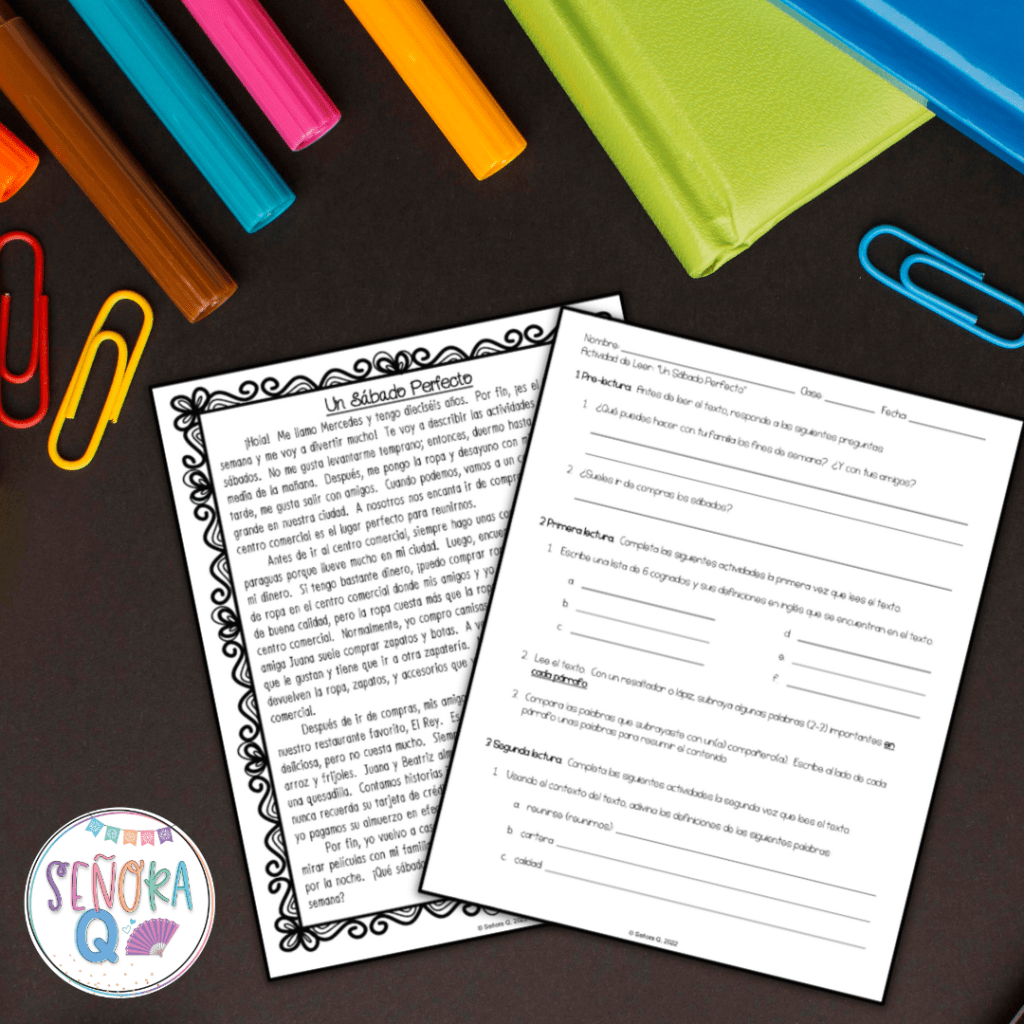
Have your students read as much as possible! There are all kinds of resources out there for you to choose from. Literally anything with Spanish words on it can be used as a reading activity! Posters, brochures/pamphlets, children’s books, advertisements – all of these are great for Spanish 1 students! If you’re not sure where to start, pull up Google and search for the topic you’re studying. Personally, I like to browse Spanish-language news sites like El Pais and BBC Mundo, but the world (or, in this case, the Internet) is your oyster. Social media posts are great too!
One thing to keep in mind: reading authentic resources in Spanish can be HARD for students. Having students practice reading strategies is really beneficial. Some of my favorites are:
- Identifying cognates
- Highlight topic sentences
- Summarize main ideas of paragraphs (this can be done in as little as a few words or a sentence)
- Use context clues to guess definitions of new words that appear in the text
Train your students to complete these activities every time they read something in Spanish, and by the time they reach AP, it will be a habit!
The interpretive reading section of the AP exam is multiple choice as well, so it’s great to have your students answer these types of comprehension questions when they read. I also like to have my students answer true/false questions, correcting any false statements and open-ended questions. I will also sometimes provide my students with true information from the text (in English), and will ask them to identify where that information is given in the text in Spanish.
Regular reading, practicing reading comprehension strategies, and answering comprehension questions will set your students on the path for AP success!
If you’re interested, check out my ready-to-print reading activities on a variety of topics here!
Skill #3: Interpersonal Writing (Email Reply)
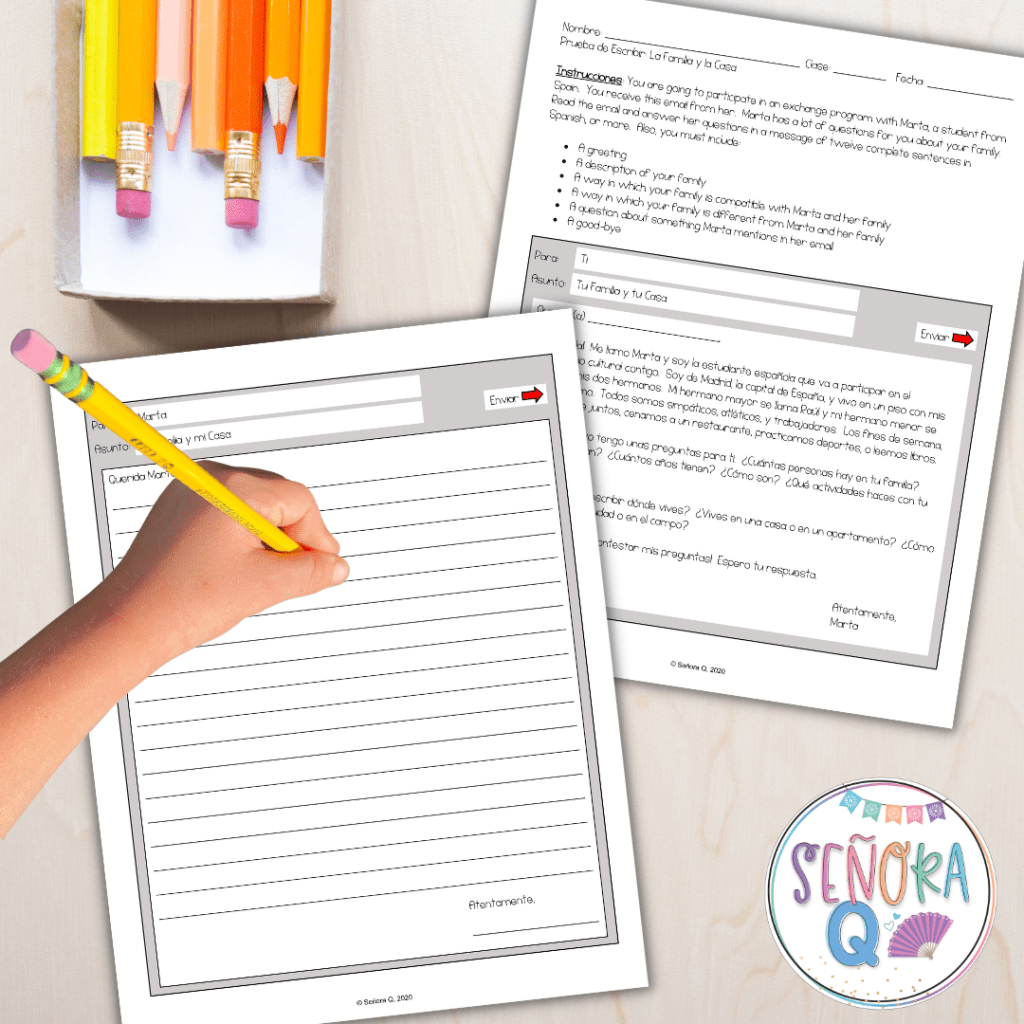
The email reply is probably my favorite task to do with Spanish 1 students! To complete this task, write an email message, using language that your students will understand. Then, give the email to your students and have them reply! The possibilities are endless – you can write an email on virtually any topic you’re studying. For example, write an email as an exchange student who is asking for introductory information from their host. You can ask students their names, how they are doing, where they are from, what they like to do, and other questions that novice-level students would be able to answer. Also, have your students ask follow-up or additional questions in their replies!
The email reply is a great opportunity to teach and practice transition words/phrases like “también,” “además,” and “por otro lado,” and important letter-writing words/phrases such as “Estimado/a” and “Atentamente.” Students will use the formal register (usted) on the AP exam, and it’s never too soon to get your students accustomed to this! (Full disclosure: I do not always have my students write email replies in the formal register, even though they will have to on the AP test. It’s okay to let them use the familiar register sometimes! As long as students repeatedly practice writing email replies, they will be able to switch back and forth as you direct them.)
Want to try a FREE email reply on family that your Spanish 1 students can totally rock? Grab it here!
Try it Free
Sign up below to receive a FREE email reply on family life that your Spanish 1 students can totally rock!

Skill #4: Interpersonal Speaking (Simulated Conversation)
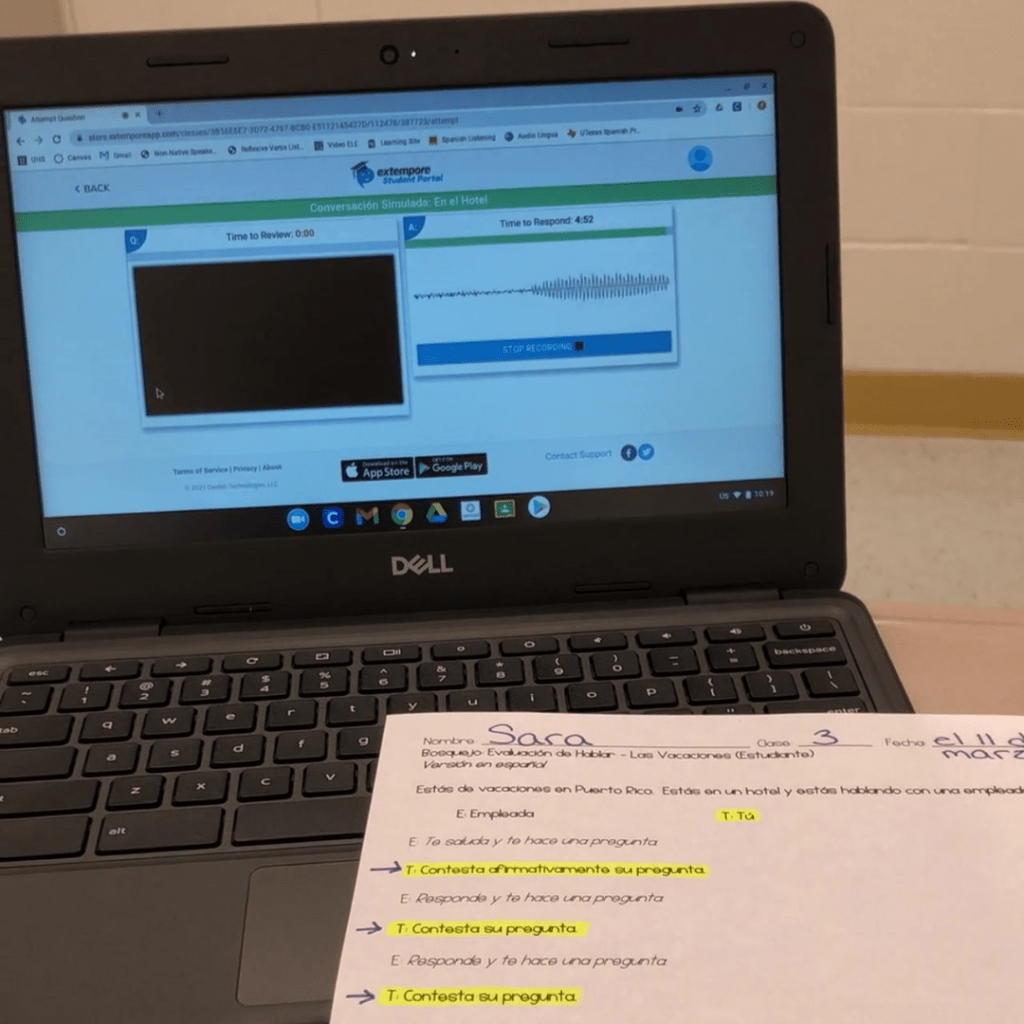
The simulated conversation can seem daunting, maybe even impossible, for novice learners, but I promise that it’s doable! You can include a simulated conversation in your very first unit! Have your students pretend they are introducing themselves to a classmate. They can exchange names, ages, how they are doing, where they are from, and so on!
The first thing you’ll need for a simulated conversation is a script. What questions/prompts are your students going to listen and respond to? Once you have your script, I recommend making a recording of you or a colleague reading it. Make sure to leave time between each question/prompt for your students to answer! (I usually leave 20-30 seconds.) A recording will be necessary if you plan to use technology to have students complete the simulated conversation!
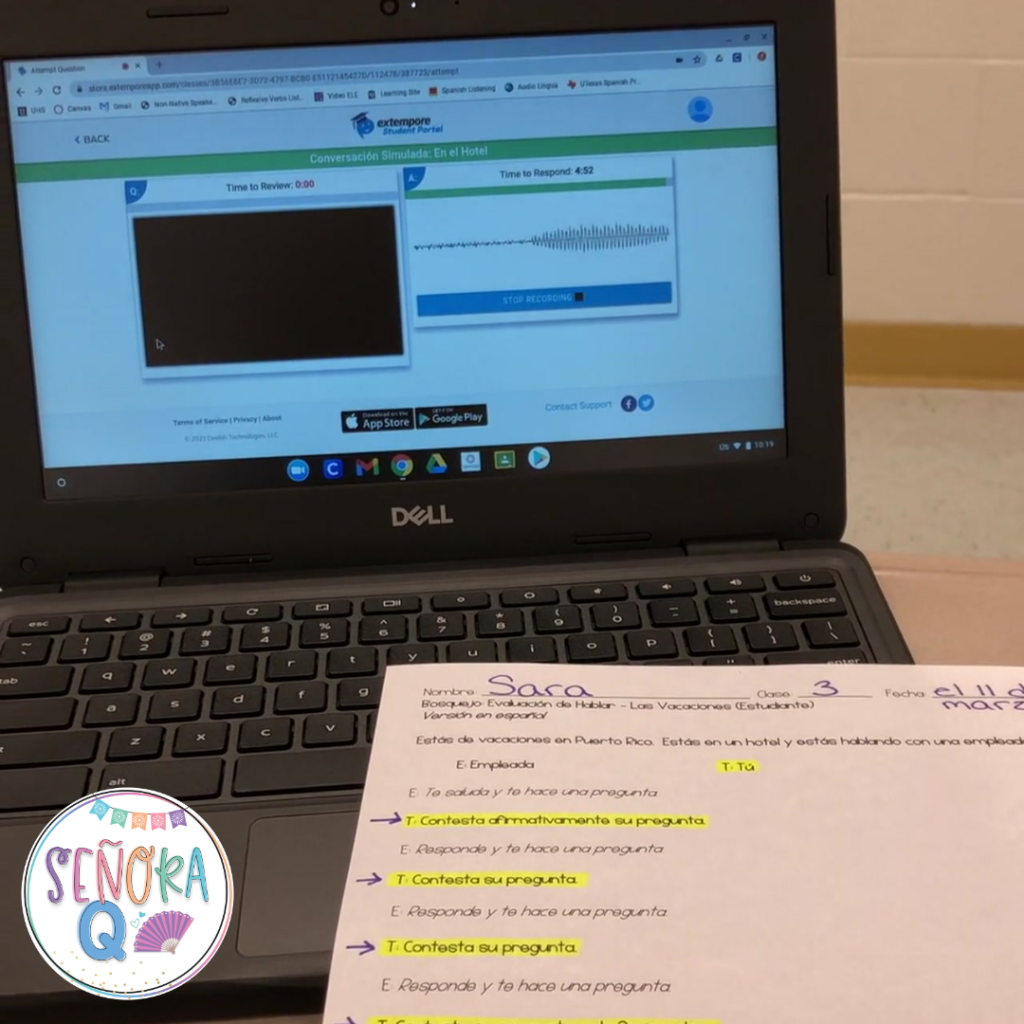
The next thing you’ll need to create is a conversation outline. Since students taking the AP exam will have an outline to help them, I make this a part of any simulated conversation activity that I do. At the top, I briefly describe the scenario so that students have some context for the conversation. Then, I provide them with prompts (but not a transcript) to help guide them through the task. Here’s an example of what one of my conversation outlines looks like:

There are lots of different ways you could go about completing a simulated conversation in your classroom. I prefer to use technology to record the conversations so I can listen to students’ responses multiple times, and to allow students to listen to their own recordings and reflect. These are some great options:
- Play your recording of the conversation through your classroom speaker and have students record their responses via the Voice Memos app (iPads/iPhones) or Camera app (Chromebooks). Other recording programs, apps, or extensions may be available for your students to use, depending on their specific devices. Have students share their recordings with you in some way (email, upload to your LMS, etc.).
- Create an assignment on your LMS (Canvas, Google Classroom, etc.), and have your students create a screen recording, giving their responses as you play the recording of the conversation. This will make it easy for you to collect students’ answers!
- Use a website such as Charlala or Extempore. Both sites can be used for free, with upgraded features available for purchase if you like.
Lastly, you will need a rubric to assess your students. Luckily, the AP rubric for interpersonal speaking works great for simulated conversations at any level! I like to use this rubric starting in Spanish 1, so that students are very familiar with it by the time they get to AP. If you feel that any criteria on the AP rubric are not applicable for your students at any given time, you can ignore them – that’s what I’ve always done in those cases!
Skill #5: Presentational Communication (Cultural Comparison)

A quick cultural comparison can be incorporated anytime you study culture in your classroom! After your cultural lesson, take a few minutes to have your students compare a cultural aspect that you studied with their own culture. For example, did you just study Día de los Muertos? Students can compare and contrast it with Halloween. School life in a particular Spanish-speaking country? Have students compare it to their own school experiences. Meal times and the sobremesa? How do those compare to students’ own meal habits?
In lower-level classes, giving a two-minute presentational comparison would be quite daunting; students need to build up to that over a period of several years. But to start, students could complete a Venn diagram, write a short paragraph (~3 sentences), or give a 30-second presentation. As time goes by, you could increase the level of difficulty or length of these comparisons so that speaking for two minutes won’t seem as scary when they get to AP.
I know that was a lot of information, profe! My final bit of advice would be that, if you’re just starting to incorporate AP tasks in your lower-level classes, don’t try to do everything at once. Pick one task to add to your current lesson or unit. In the next one, choose a different task and try it. Add more tasks to your units as you feel more comfortable with them!
Thank you for reading! If you’ve tried any of these activities recently, I’d love to know how it went! Let me know below! ¡Hasta pronto!
 Señora Q